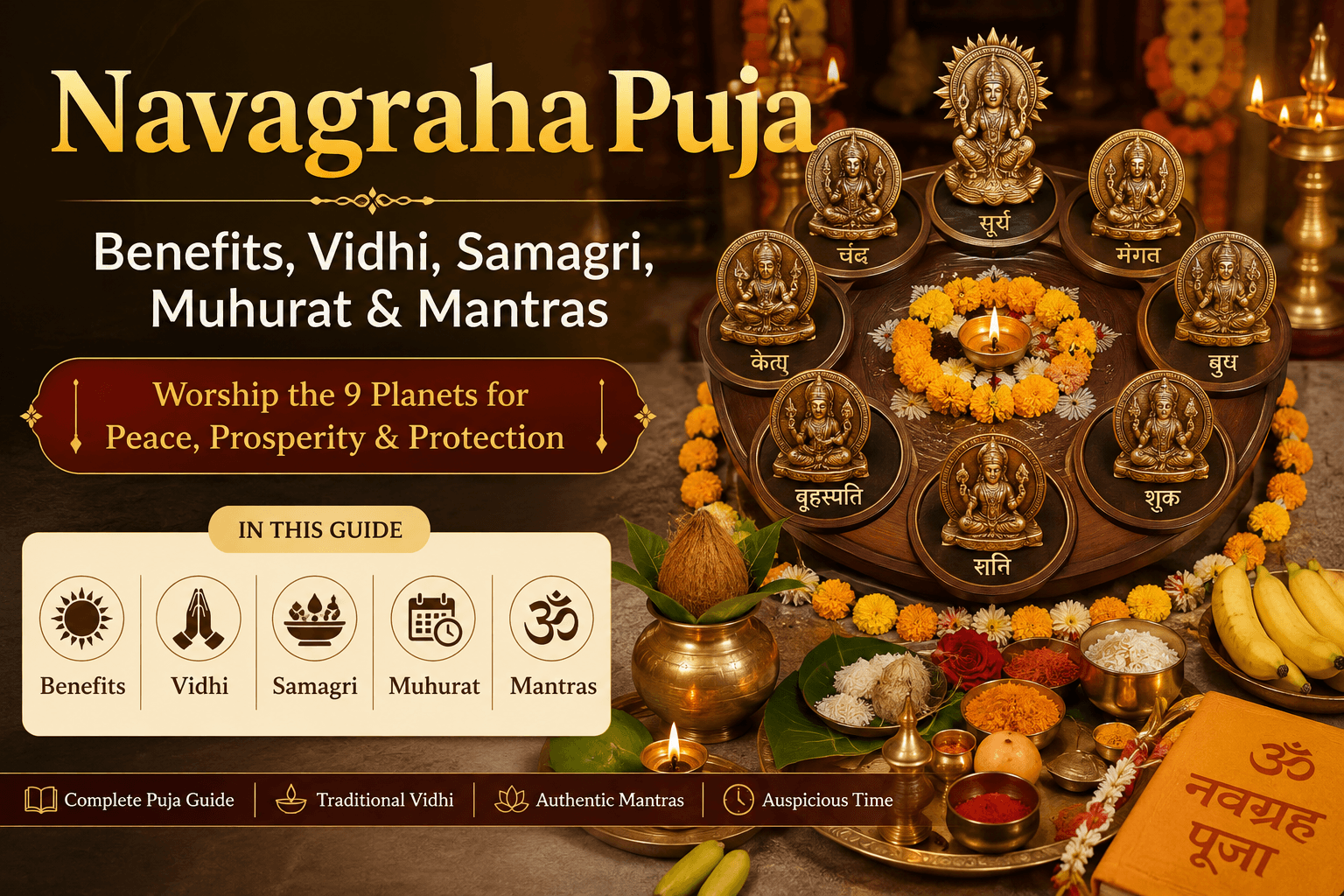
Discover the complete guide to Navagraha Puja, including its traditional benefits, puja vidhi, samagri, auspicious muhurat, mantras, and important FAQs. Learn about the nine grahas, the significance of their worship, and how to prepare for a Navagraha Puja with the right guidance.
Navagraha Puja is a traditional Hindu ritual dedicated to the nine grahas - Surya (Sun), Chandra (Moon), Mangal (Mars), Budha (Mercury), Brihaspati or Guru (Jupiter), Shukra (Venus), Shani (Saturn), Rahu and Ketu. In Jyotisha traditions, these grahas are considered important in interpreting a person's birth chart and planetary influences. A Navagraha Puja is performed as a form of prayer and propitiation, particularly when a family follows a traditional astrological recommendation for graha shanti or related remedies.
This guide explains the traditional significance of Navagraha Puja, the nine grahas involved, the basic puja vidhi, commonly used samagri, mantras, timing considerations, cost factors and frequently asked questions.
What Is Navagraha Puja?
The word Navagraha refers to the nine grahas recognized in Hindu astrology: Surya, Chandra, Mangal, Budha, Brihaspati, Shukra, Shani, Rahu and Ketu. The traditional system includes seven visible celestial bodies along with Rahu and Ketu, which are understood in Jyotisha as the lunar nodes rather than physical planets.
Navagraha Puja is a ritual in which these nine grahas are worshipped through invocation, offerings, mantras, prayers and other prescribed practices. A concise Navagraha Puja procedure documented by Drik Panchang includes invocation of the nine grahas, Dashopachara-style offerings and a concluding prayer for graha shanti.
The exact procedure can differ according to the sampradaya, priest, region, purpose of the puja and the ritual being performed. Therefore, a home prayer and a full priest-led Navagraha Shanti Puja should not necessarily be treated as identical rituals.
The Nine Grahas in Navagraha Puja
| Graha | Sanskrit name | Traditional association |
|---|---|---|
| Sun | Surya | Vitality, authority and self |
| Moon | Chandra | Mind, emotions and mental temperament |
| Mars | Mangal | Courage, energy and action |
| Mercury | Budha | Communication, intellect and learning |
| Jupiter | Brihaspati / Guru | Knowledge, wisdom and guidance |
| Venus | Shukra | Relationships, beauty and comforts |
| Saturn | Shani | Discipline, responsibility and patience |
| Rahu | Rahu | Desire, material ambition and unconventional experiences |
| Ketu | Ketu | Detachment, spirituality and introspection |
These associations belong to the traditional Jyotisha framework and should be understood as astrological or religious interpretations rather than scientific claims. Contemporary astronomy does not treat all nine Navagrahas as physical planets.
Why Is Navagraha Puja Performed?
People may choose Navagraha Puja for different traditional or devotional reasons.
Common reasons include:
- Seeking graha shanti according to a Jyotisha recommendation
- Performing a general prayer dedicated to all nine grahas
- Marking an important family or religious occasion
- Following a traditional remedy associated with a horoscope
- Seeking spiritual peace, discipline and a sense of devotional focus
- Performing a puja when a priest or astrologer recommends worship of multiple grahas rather than one specific graha
It is important to distinguish traditional religious beliefs from guaranteed real-world outcomes. A puja should not be presented as a guaranteed method of curing disease, producing wealth, securing marriage, getting a job or changing a person's future.
What Are the Traditional Benefits of Navagraha Puja?
Different traditions describe different benefits of Navagraha worship. These benefits are religious and astrological beliefs rather than scientifically established outcomes.
Devotees commonly associate the puja with:
1. Graha Shanti
The central purpose of a Navagraha Shanti ritual is traditionally associated with seeking peace or propitiation in relation to the nine grahas.
2. Spiritual Discipline
Participating in a structured puja involves prayer, mantra recitation, offerings and focused attention. For many devotees, this creates a regular spiritual practice.
3. Worship of All Nine Grahas
A person may choose a Navagraha Puja when they want to worship all nine grahas rather than focusing on only one planetary influence.
4. Traditional Astrological Remedy
When a Jyotisha practitioner identifies a particular planetary concern in a birth chart, a Navagraha-related ritual may be suggested as one traditional remedy.
5. Religious and Family Observance
Families may also perform Navagraha Puja as part of a broader religious ceremony, before an important occasion or as a devotional practice.
The appropriate ritual depends on the person's circumstances and the tradition being followed. A generalized statement that every person "needs" Navagraha Puja should be avoided.
Navagraha Puja Vidhi: How Is It Performed?
A complete ritual varies by tradition and purpose. A simplified structure can include the following stages.
Step 1: Preparation
The puja space is cleaned and the required samagri is arranged.
A priest may prepare a kalasha and establish the items or representations used for worship of the nine grahas.
Step 2: Sankalpa
The yajamana or devotee makes a sankalpa, stating the intention of the ritual.
The wording and procedure can vary according to the priest and ritual tradition.
Step 3: Ganesh and Preliminary Worship
In many Hindu ritual traditions, preliminary worship is performed before the principal ceremony.
This may include prayers to Lord Ganesha and other customary preparatory steps.
Step 4: Navagraha Avahana
The nine grahas are invoked through prescribed mantras.
A documented concise Navagraha Puja procedure invokes Surya, Chandra, Mangal, Budha, Brihaspati, Shukra, Shani, Rahu and Ketu collectively.
Step 5: Offerings
The priest performs the prescribed offerings, which may include:
- Water
- Gandha or sandalwood
- Akshata
- Flowers
- Incense
- Lamp
- Naivedya
- Tambula
- Dakshina
The exact materials and sequence can vary. Drik Panchang's documented concise procedure lists these categories of Dashopachara offerings.
Step 6: Graha Mantra and Prarthana
Mantras associated with the nine grahas are recited according to the ritual being conducted.
The exact mantra, count and sequence should be verified with the priest or tradition being followed. SanskritDocuments also preserves collections of Navagraha mantras attributed to different traditional sources.
Step 7: Havan or Homam
Some forms of Navagraha worship include a Havan/Homam with offerings into the sacred fire.
This is not necessarily included in every Navagraha Puja, so the devotee should confirm what the chosen package or ritual actually includes.
Step 8: Final Prarthana and Aarti
The ceremony concludes with prayers and, depending on the tradition, aarti, offering of dakshina and blessings from the priest.
Navagraha Puja Samagri List
The exact Navagraha Puja samagri depends on the ritual format and regional tradition.
A general preparation list can include:
- Kalasha
- Water
- Akshata (rice)
- Sandalwood or gandha
- Flowers
- Incense
- Ghee lamp
- Naivedya
- Fruits
- Betel leaves
- Betel nuts
- Turmeric
- Kumkum
- Cotton wicks
- Puja cloth
- Items required for the specific graha worship
- Havan samagri, if homam is included
Do not publish a single "official" samagri list as though every tradition uses exactly the same materials. The list can change according to the priest, sampradaya, regional practice and whether the ceremony includes homam or other additional rituals.
Navagraha Mantras
There is no single universal mantra list that should automatically be presented as the only correct Navagraha mantra set. Different traditional texts and ritual systems preserve different mantras.
For example, SanskritDocuments hosts a Navagraha mantra collection containing individual mantras for Surya, Chandra, Mangal, Budha, Brihaspati, Shukra, Shani and other grahas.
A commonly cited collective Navagraha prayer in a concise puja procedure is:
ब्रह्मा-मुरारिस्त्रिपुरान्त-कारी भानुः शशी भूमिसुतो बुधश्च। गुरुश्च शुक्रः शनि-राहु-केतवः सर्वे ग्रहाः शान्तिकरा भवन्तु॥
The appropriate mantra and repetition count should be selected according to the ritual tradition being followed rather than simply choosing a number from an online article.
When Should Navagraha Puja Be Performed?
There is no single universally applicable date or time for every Navagraha Puja.
The appropriate timing can depend on:
- The purpose of the puja
- The person's birth chart
- The graha being addressed
- The regional or family tradition
- The priest's ritual calendar
- Muhurat considerations
- Whether the ceremony is associated with another religious event
Some practitioners recommend selecting a muhurat based on the horoscope and the specific purpose of the ceremony.
For this reason, avoid claims such as "Navagraha Puja must always be performed on [one fixed day]."
A better approach is to determine the timing based on the ritual being performed and consult a qualified priest or astrologer when a personalized muhurat is required.
Navagraha Puja Cost in India
The cost of Navagraha Puja varies significantly.
It can depend on:
- Number of priests
- Ritual duration
- Whether homam is included
- Samagri provided
- Temple or venue
- Location
- Additional offerings
- Dakshina
- Whether the ceremony is conducted online or in person
Current online listings show substantial variation in Navagraha-related services. For example, one online puja provider currently lists a one-day Navagraha Puja at ₹5,100 and a five-day option at ₹21,000, while other providers list different prices depending on the ritual format.
For PoojaPath Digital, your article should not copy competitor prices. Instead, show your actual package price, exactly what it includes and what is excluded.
That makes the page substantially more useful to a potential customer.
Navagraha Puja vs Navagraha Homam
These terms are often used together, but they should not automatically be treated as identical.
Navagraha Puja generally refers to worship and offerings directed toward the nine grahas.
Navagraha Homam/Havan includes a fire ritual in which prescribed offerings are made into the sacred fire alongside the relevant mantras.
Some services combine both.
Before booking, ask:
Does the package include only puja, or does it also include Navagraha Homam?
That one question can prevent confusion about what you are actually purchasing.
Is Navagraha Puja Necessary for Everyone?
No single ritual is automatically necessary for everyone.
Some people perform Navagraha Puja because of personal faith or family tradition. Others perform it following a recommendation from a priest or astrologer based on their horoscope.
If the concern relates specifically to one graha, a practitioner may recommend a more specific ritual rather than a general Navagraha ceremony.
For a personalized recommendation, a qualified astrologer or priest can review the relevant details and explain why a particular ritual is being suggested.
Can Navagraha Puja Be Performed Online?
Online puja services are increasingly offered for devotees who cannot travel to a temple or have a priest visit their home.
However, "online" can mean different things.
Before booking, verify:
- Where the puja is actually performed
- Whether a priest performs the physical ritual
- Whether the devotee's name and sankalpa are included
- Whether live video is provided
- Whether the ceremony is recorded
- Whether prasadam is included
- Which samagri is used
- Whether homam is included
- Whether a receipt or completion details are provided
A transparent service page should explain these details rather than simply saying "100% authentic online puja."
How to Choose a Priest for Navagraha Puja
Choosing a priest should involve more than looking at the cheapest package.
Before booking, check:
Priest information
Look for a clear explanation of the priest's experience, tradition or qualifications.
Ritual transparency
The service should explain what will actually be performed.
Real photographs
Real photographs of actual ceremonies are more useful than generic stock imagery.
Clear pricing
The customer should know what is included.
Customer support
There should be a clear way to ask questions before booking.
Reviews and evidence
Use genuine customer feedback and real ceremony evidence rather than fabricated testimonials.
These trust signals are particularly important when users are paying for a religious service online.
Common Questions About Navagraha Puja
What is Navagraha Puja?
Navagraha Puja is a traditional Hindu ritual dedicated to the nine grahas - Surya, Chandra, Mangal, Budha, Brihaspati, Shukra, Shani, Rahu and Ketu.
What are the benefits of Navagraha Puja?
Traditionally, devotees associate the ritual with graha shanti, devotional practice and astrological remedies. These are religious and astrological beliefs, not guaranteed outcomes.
What is included in Navagraha Puja?
Depending on the ritual, it may include sankalpa, invocation, offerings, mantra recitation, graha worship, prayers and sometimes homam.
What samagri is required?
Common items include flowers, akshata, sandalwood, incense, a lamp, fruits, naivedya and other ritual materials. The exact list varies by tradition.
What is the best time for Navagraha Puja?
The appropriate timing depends on the purpose, tradition and sometimes the devotee's horoscope. There is no single date that applies to everyone.
How much does Navagraha Puja cost?
The cost varies according to the priest, location, duration, samagri, number of priests and whether homam or additional rituals are included.
Can Navagraha Puja be performed online?
Some providers offer online ceremonies. Customers should verify where the physical ritual is conducted and exactly what the package includes.
Should I perform Navagraha Puja or a specific Graha Puja?
That depends on the purpose. A priest or astrologer may recommend worship of all nine grahas or a specific graha based on the individual's circumstances and tradition.
Final Thoughts
Navagraha Puja is a significant traditional form of planetary worship within Hindu religious and Jyotisha practices. Understanding the purpose of the ritual, the nine grahas, the procedure, samagri and timing can help devotees make a more informed decision.
The most important point is to choose a ritual that is appropriate for your purpose and to understand exactly what the ceremony includes.
For devotees who prefer a professionally coordinated ceremony, PoojaPath Digital offers Navagraha Puja booking with a clear process and service details.
Book Navagraha Puja with PoojaPath Digital →
Related Guides
- Ketu Dosha: Meaning, Signs and Traditional Remedies
- Ketu Jaap: Mantra, Jaap Sankhya and Vidhi
- Maha Mrityunjaya Jaap: Meaning, Vidhi and Traditional Significance
- Rudrabhishek Puja: Vidhi, Samagri and Best Days
- Graha Shanti vs Navagraha Puja: What Is the Difference?
- Navagraha Mantras: Traditional Mantras for the Nine Grahas
Get your Kundli guide & talk to an astrologer
A detailed Janam Kundli (~500 pages) plus a 1-hour live session with an experienced astrologer — career, marriage, doshas, dashas, and personalised remedies — for ₹2,100.
You can also book a puja as an online puja, puja at home, or temple puja.
Topics
PoojaPath